Have you ever watched a student go through the motions of a lesson — completing every task you set, getting most of the answers right, and ending with the same flat energy they brought in? Technically, the lesson worked. Practically, you've lost them.
A strong teacher-student relationship is what turns "the lesson worked" into "the student wants to come back." It's also what decides whether a student recommends you to a friend, brings their younger sibling next year, or quietly drops you when something else gets in the way.
Online tutoring makes this harder. Without corridor chat, after-class lingering, or the body-language cues you'd catch in a physical classroom, the relationship has to be built deliberately — inside the lesson itself, by what you say and how you set things up.
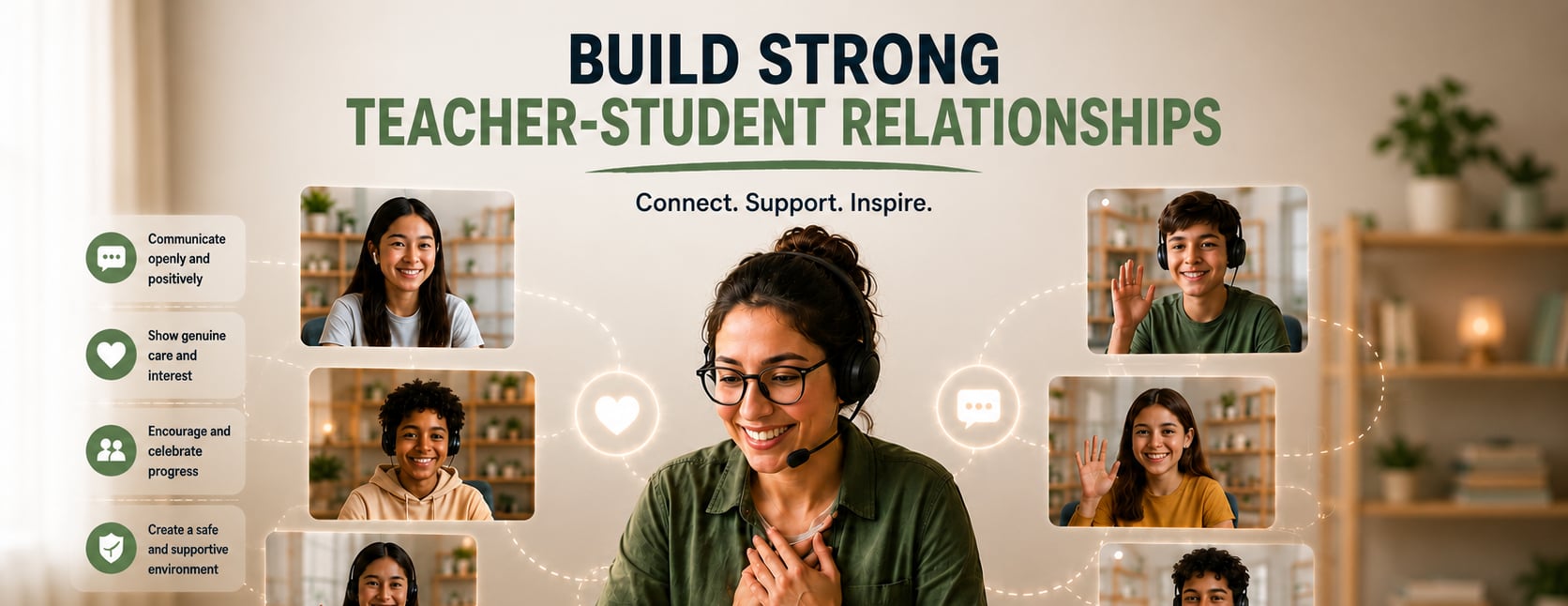
This guide breaks down seven concrete habits that experienced online tutors use to turn a one-way classroom into a trusting two-way relationship. None of them require talent or a special personality. All of them are choices you can make in your next lesson.
So let's dive in.
Why Teacher-Student Relationships Matter More Online
In a physical classroom, dozens of micro-interactions happen for free. The wave at the door, the side comment between tasks, the eye contact when a student is struggling. They build trust whether you actively work on them or not.
Online, almost none of that happens by default. The student joins a call, looks at a screen, and leaves. If you don't deliberately make space for connection — a quick personal question, a real-time reaction, a shared joke — the lesson is just a transaction. Transactions are easy to cancel.
The good news is that everything that used to happen by accident can be engineered. Below are seven habits that consistently show up in the practice of online tutors with high retention, strong word-of-mouth, and the freedom to keep raising their rates.
1. Respect and Understanding
Respect online starts with the smallest things and the student notices every one of them. Be on time. Use the student's name in the first sentence of the lesson, not the fifth. Remember what they told you last time — the upcoming exam, the trip to their grandmother, the new puppy — and ask about it.
Treat the student's opinion as evidence, not as a hurdle. If they say "I don't like role plays," don't argue. Ask why. You'll either learn something about how they learn, or you'll find that the resistance was about a specific format you can change.
Concrete habits that signal respect:
- Keep a one-line note in the student's profile after each lesson — what happened in their week, what they're proud of, what they're worried about. Reference it next time.
- Ask permission before changing the plan. "I think we should spend the next 15 minutes on pronunciation instead of grammar — does that sound okay?" gives the student agency.
- Don't talk over the student, even when they're slow. Online video adds 200–400 ms of lag. What feels like "they finished" is sometimes "they're about to say the second half."
2. Empathy and Support
Empathy is noticing that the student isn't fine before they tell you. Online, you have fewer signals than in a classroom, but you have some: short answers, slower replies, the camera switched off, an unusual silence after a question.
When you notice, name it gently and offer choices. "You seem a bit quieter than usual today — do you want to keep going at the same pace, or take it easier and pick up next time?" lets the student decide whether to push through or take care of themselves.
The mistake to avoid is overcorrecting into therapy mode. You're the student's tutor, not their counsellor. Acknowledge, offer flexibility, then move on. The acknowledgement alone tells the student that you see them as a person — that's what they remember.
One concrete pattern: always start the first lesson after a long break (illness, holiday, exam stress) with five minutes of low-pressure conversation. Skip new material. Let the student warm up. The cost is small. The signal that you're not a content-delivery robot is enormous.
3. Clear Expectations and Fairness
Students relax when they know the rules. They tense up when the rules seem to change.
Lay out the basics in your first lesson and don't change them silently afterwards. How long is the lesson? What happens if the student is late, or you are? What's the cancellation window? How will homework be marked? What does "improvement" look like in your scheme?
The same applies to feedback inside a lesson. Be specific and consistent. "Your past simple is solid; we still need to work on the third-person -s in present simple — that's the next thing" is fair, factual, and gives the student a clear next move. "Your grammar is bad" is none of those.
If you make a rule, apply it the same way to every student. If you waive a late-cancellation fee for one student's emergency, write down what the threshold is, so the next student in a similar situation gets the same treatment. Fairness isn't strictness — it's predictability.
4. Positive Reinforcement
Generic praise is noise. "Good job!" after every answer is the verbal equivalent of a participation trophy — the student stops believing it, and they stop noticing real wins.
Specific praise tells the student exactly what they did well and why it matters. Three patterns to use:
- Name the skill, not the outcome. "You used the conditional correctly there without thinking about it" is better than "Correct!" — it points to the underlying ability.
- Compare to past self, not other students. "Two months ago you couldn't have written that sentence" is much more motivating than "That's better than most of my students."
- Make progress visible. Keep a running list of mistakes the student used to make that they no longer make. Show it to them once a month. "These ten errors stopped appearing — that's the work paying off."
For younger students, micro-celebrations work: a star next to a topic on the lesson board when they nail it, a streak counter for vocabulary words held over multiple lessons. For adults, the visible-progress conversation is what lands.
5. Collaboration and Engagement
A lesson where the teacher does 80% of the talking is a lesson the student will forget. A lesson where the student does 50% of the writing and clicking is one they'll remember.
Get the student onto the board. Don't just share your screen and present — give them their own colour on the interactive whiteboard and let them write, drag, underline, and correct alongside you. The shift from "watching" to "co-authoring" changes the relationship instantly. You become two people working on the same problem, not a sender and a receiver.
Two more habits that turn passive lessons into collaborative ones:
- Let the student pick the next topic. Once a month, end a lesson by asking "What do you want to focus on next time?" If their answer doesn't match your plan, adjust. The buy-in is worth more than the perfect curriculum.
- Use real-time reactions instead of "Do you understand?" Most students say yes when they don't. Agree on a signal in lesson one — thumbs up for "got it", thumbs down for "slow down" — and keep it on screen. Students who feel safe to signal confusion fix problems faster, and they trust you more because you noticed.
6. Leading by Example
Students copy the behaviour you model, not the behaviour you preach. If you want them to take the lesson seriously, you have to take it seriously yourself.
Be on time, every time. Have your camera on. Have your materials ready before the lesson starts — opening a tab or hunting for a file in the first two minutes signals "this is not important to me." If you have to apologise for being unprepared, the student learns that being unprepared is acceptable.
Admit your own mistakes openly. If you give a wrong answer, correct yourself in the next lesson without skating around it. "I told you last week that X is uncountable — actually it can be countable in this context. Here's the full picture." The student learns two things: how to handle a mistake, and that you respect them enough to be honest.
Show curiosity about what you teach. Online students are very good at sensing when a tutor is bored of the topic. If conditionals bore you in 2026, find the angle that doesn't — the angle a native speaker would care about, the news story that uses them, the song. Your interest is contagious.
7. Continuous Growth and Learning
The most respected tutors are the ones who keep learning out loud.
Tell your students about a course you're taking, a book you're reading, a method you tried that didn't work and what you're trying instead. This does three things at once: it positions you as a professional, not a hobbyist; it normalises learning as a lifelong activity for the student; and it gives the student permission to fail and try again, because their tutor does too.
Once or twice a year, ask each student for feedback. Not "is everything okay?" but specific questions: "What part of our lessons do you find most useful? What's the least useful 10 minutes?" The answers will sometimes sting, but the signal you send is "your experience is something I'm working on." That alone is worth more than most of the changes you'll make as a result.
Track your own progress as a tutor the way you track theirs. Keep a simple log of what worked, what didn't, what you want to try. A tutor who can show real growth over time keeps students in a way that a static "good enough" tutor never will.
The Tool That Ties It All Together
Each habit above works on its own. They work better when your setup gets out of the way.
A virtual classroom built for tutors combines your video call, interactive whiteboard, homework, lesson notes, and progress tracking in a single tab. No switching between Zoom, Miro, Google Docs, WhatsApp, and a spreadsheet. No technical scramble in the first two minutes. No "let me share the link again."
The cognitive load you save with an integrated environment goes straight back into the relationship. When the technology disappears, you can actually be present for the student. That's what the seven habits add up to.
Frequently Asked Questions
How long does it take to build a strong teacher-student relationship online?
Usually four to six lessons of consistent behaviour, sometimes faster with adult learners and slower with teenagers. Trust shows up in small ways first: the student volunteering a story unprompted, asking a question they wouldn't have asked before, choosing your slot when their schedule is tight. If you see none of those signals after six lessons, treat it as a signal that something specific isn't working — ask the student directly, in a low-pressure moment, what they'd change.
What if a student doesn't seem to want a relationship?
Some students arrive defensive — especially teenagers and adults who've had bad experiences with teachers in the past. Don't push warmth. Be consistent, professional, and calmly curious about them. Trust builds with predictability over weeks, not with effort in a single lesson. Once they trust you're not going to embarrass or judge them, the relationship usually opens up on its own.
How do I stay warm without losing professional boundaries?
A strong relationship doesn't require oversharing or being available 24/7. Reply to messages in a fixed window (for example, weekdays from 9 a.m. to 6 p.m.). Keep your own personal life largely out of lesson chat. End lessons on time without apologising. Boundaries themselves are a form of respect — students trust tutors who respect their own time.
How is building rapport online different from building it in person?
Online removes most of the incidental cues — the small talk before the lesson, the body language at the door, the quick check-in between activities. You have to build them in deliberately: ask one personal question every lesson, keep your camera on even when the student is writing, react in real time so the student knows you're with them. The relationship is exactly as warm as the one you'd build in person — it just requires more intent.