
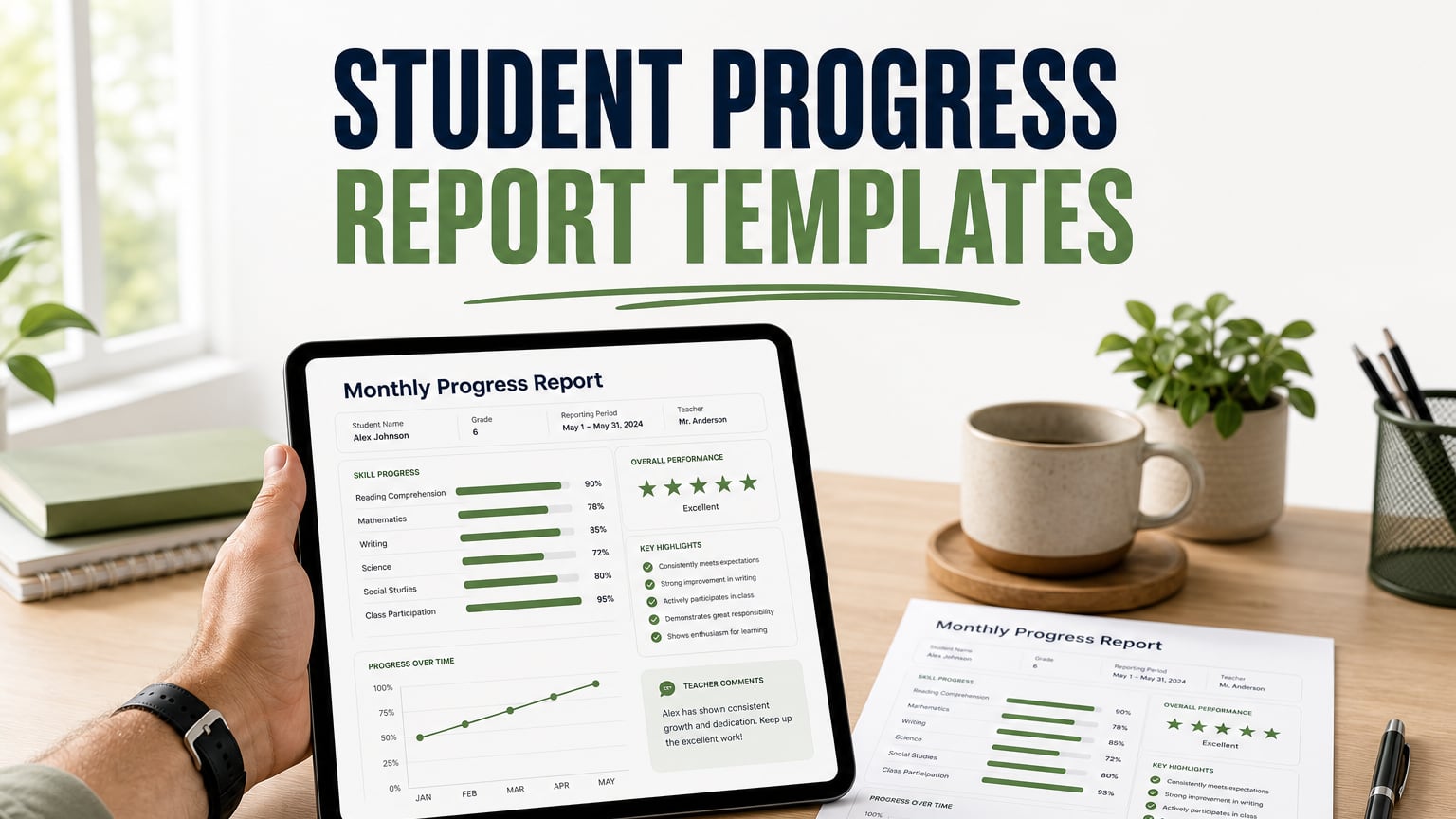
Most online tutors don't send progress reports. It's not that they think it's a bad idea—most actually like the idea—but it feels like a big task that takes time they don't have. It's easy to keep putting it off until it just never gets done.
This has real consequences. When students and parents don't get regular, written updates, they have to rely on their feelings alone. If they feel good, they stick with it. But if they feel neutral—which happens a lot for language learners since progress is slow and hard to notice—they start to question whether they should keep going.
A quick progress report, written in five minutes and sent once a month, can make a big difference. It turns a general good feeling into real proof. It also answers the question every student and parent is quietly wondering—is this working?—before they have to ask.
This article shares five templates you can use in common tutoring situations, along with a note-taking habit that makes writing reports easy. For a complete system, check out how to track student progress in every lesson.
What to Include in Every Student Progress Report
Before looking at templates, let's talk about the key parts. No matter the subject, student age, or report length, every good progress report covers these six points:
1. What the student can do now that they couldn't do at the start. This is the heart of the report and gives readers the most encouragement. Be specific: instead of "Emma has improved her speaking," say "Emma now uses conditional sentences in conversation without prompting. She avoided them entirely in October."
2. What the student is working on right now. This shows the reader that lessons have a clear direction, not just random content. It also answers the question: "What am I paying for at this moment?"
3. A specific strength you noticed during this time. Give one real, concrete example instead of general praise. For example, "Jamal retains new vocabulary exceptionally well after seeing it once in context" is better than "Jamal is a very hardworking student."
4. The main area for growth. Focus on what the student is working to improve. Describe it as a learning goal, not a weakness. For example: "We're building fluency in extended speaking, which means speaking for two or more minutes on a topic.
5. The plan for the next period. In one or two sentences, explain what the focus will be for the next month. This helps the reader see the report as part of a bigger story, not just a one-time update, but as an ongoing story.
6. A clear invitation for questions or feedback. This keeps communication open and makes it more likely you'll get honest responses before someone decides to cancel. For example: "If you have any questions about this or want to talk about anything, please reply to this message. I'm happy to chat."
How Often Should You Send Progress Reports?
For children and teenagers: once every three to four weeks, at minimum. Parents are paying and need regular evidence of value. Waiting for a termly report is too long — three weeks of silence from a tutor is enough time for parental doubt to solidify into a cancellation conversation.
For adult students: once a month. Adults are self-directed and generally don't need the same frequency as parents of younger students, but they do benefit from a structured monthly check-in that documents what they've achieved and what comes next.
For IELTS and exam candidates: every two weeks, or at each mock exam attempt. The timeline is compressed and the stakes are high — students and families want regular updates that map progress against the target score and the exam date.
For all students after a good session: a brief mid-period note is never wrong. If a student has a breakthrough moment — uses a structure correctly for the first time, scores significantly better on a practice test, completes a task they previously found impossible — a one-paragraph message that names that moment costs two minutes and produces disproportionate goodwill.
The five templates below cover all contexts. Copy the format that fits, adapt the placeholder text to your student, and send. The whole process, once you have the habit, should take three to five minutes per student.
Template 1: Monthly Progress Report for Parents (Children and Teens)
For students aged 8 to 18. Send this report to parents or guardians. The tone should be warm, professional, and specific.
Subject: [Student name]'s progress update for [Month]
Hi [Parent name],
I wanted to share a quick update on how [Student name]'s lessons have been going this month.
What [he/she/they] has achieved: [Student name] [specific achievement, for example: "can now read and understand texts at a B1 level independently, without needing to pause and translate. In September, this level of text required significant support."]
What we're working on right now: This month we're focused on [specific skill, for example: "writing topic sentences clearly in paragraphs, which is a key skill for the Year 9 English assessments coming in spring"].
Something I noticed: [Student name] [specific strength, for example: "has a strong instinct for narrative structure. When she writes stories, the pacing is noticeably better than students twice her age."]. This is a genuine ability worth developing.
What we're building toward: In [next month], we'll start working on [next focus area]. By the end of next month, the goal is for [Student name] to [specific measurable outcome].
If you have any questions or if there is anything specific you would like me to focus on, please let me know. I'm always happy to hear from you.
[Your name]
Adaptation notes:
- Fill in the bracketed sections with details from your own lesson notes.
- Try to keep your message between 150 and 200 words. Parents are more likely to read shorter messages right away, while longer ones might be put off until later.
- Send your message by email or WhatsApp, depending on how you usually communicate with this family.
Template 2: Monthly Progress Update for Adult Students
For use with adult learners aged 18 and over. The tone should be direct, collegial, and peer-to-peer, not aimed at parents.
Subject: Your progress this month: [Month]
Hi [Student name],
Here's a quick update on how you're doing after this month's lessons.
What's changed: [Specific progress, for example: "Your speaking fluency in business contexts has improved a lot. You now use hypothetical situations like 'if we were to...' naturally in conversation. Six weeks ago, this was a real challenge for you."]
What we're working on: Right now, we're focusing on [specific area, for example: "academic writing precision, especially building arguments that move smoothly from point to evidence to analysis without repeating ideas"]. You're making good progress here.
One thing I'd like to highlight: [Specific strength, for example: "Your vocabulary range is much wider than most students at your level. You aren't searching for words; you're choosing between them. That really sets you apart."]
Next month: We'll start working on [next focus]. If you keep up this pace, you should be [projected outcome, for example: "ready to sit the IELTS in February"].
Let me know if you'd like to change our focus at any point. I'm always open to your feedback.
[Your name]
Adaptation notes:
- If you want a more casual tone, you can leave out the title "Monthly Progress Update."
- Adult students appreciate directness. Using clear and precise language shows more respect than offering vague reassurance.
- If progress this month was limited, be honest: "We've been consolidating the ground we covered in October. That kind of slow work matters even when it's not visible yet."
Template 3: ESL / Language Learning Progress Report
Use this template for English language learners at any level (A1 to C2). You can send it to the student, parents, or both. It covers all four core language skills.
Subject: English progress update — [Student name] — [Month]
Hi [Name],
Here is [Student name]'s English progress update for [Month].
Skill breakdown:
- Speaking — Current level: [e.g. B1+] — Progress this month: [e.g. "More confident in extended responses. Less pausing."]
- Listening — Current level: [e.g. B2] — Progress this month: [e.g. "Strong. No significant issues at natural speech rate."]
- Reading — Current level: [e.g. B1] — Progress this month: [e.g. "Working on inference — understanding implied meaning."]
- Writing — Current level: [e.g. B1–] — Progress this month: [e.g. "Main focus this month. Paragraph structure improving."]
Vocabulary: This month we focused on [topic vocabulary, for example, academic collocations, cause-and-effect language, or hedging phrases]. From previous sessions, [student] has kept most new words, with about 80% retention on tested vocabulary.
Grammar focus: We continued practicing reported speech. [Student name] uses this correctly in writing. Spoken use is still not always consistent, but it is getting better.
Error patterns: The main recurring error this month was using articles with uncountable nouns, such as 'an information' or 'a knowledge.' We have worked on this directly, and the number of mistakes is going down.
Next month, we will focus on [specific skill], aiming for [specific measurable outcome].
If you have any questions, please get in touch.
[Your name]
Adaptation notes:
- You can make the skill table shorter, with just two or three rows, if the student is working on specific skills like speaking and writing.
- For very young learners, use bullet points in simple language instead of a table.
- The error pattern section is especially helpful for parents because it shows that mistakes are being tracked and addressed in a clear, organized way, not just noticed.
Template 4: IELTS / Exam Preparation Progress Report
Use this template for students getting ready for IELTS, TOEFL, CAE, or similar exams. It helps track scores and timelines.
Subject: IELTS prep update — [Student name] — [Month]
Hi [Name],
Here is [Student name]'s IELTS preparation progress for [Month].
Current score estimate (based on practice work this month):
- Listening — Target band: [e.g. 7.0] — Current estimate: [e.g. 6.5] — Change from last month: [e.g. +0.5]
- Reading — Target band: [e.g. 7.0] — Current estimate: [e.g. 7.0] — Change from last month: [e.g. on target]
- Writing — Target band: [e.g. 7.0] — Current estimate: [e.g. 6.0] — Change from last month: [e.g. +0]
- Speaking — Target band: [e.g. 7.0] — Current estimate: [e.g. 6.5] — Change from last month: [e.g. +0.5]
- Overall — Target band: [7.0] — Current estimate: [6.5 est.]
Key progress this month: [Specific improvement, for example: "Task 1 Academic Writing has improved a lot. [Student name] now structures overview paragraphs well and chooses data carefully. This was the weakest area four weeks ago."]
Main focus for next month: Writing Task 2 argument structure. [Student name] has strong ideas, but the paragraphs need clearer topic sentences and better support. This is the best way to reach a 7.0-line assessment: [e.g., "At the current rate of progress, [Student name] should be ready to sit in [month]. If Writing Task 2 improves as expected over the next four weeks, I'm confident in a 7.0 overall."]
If there is anything you would like to discuss before our next session, please let me know.
[Your name]
Adaptation notes:
- Be honest about timelines. If you make predictions that are too optimistic and then miss them, it hurts trust more than giving a cautious estimate and then doing better than expected.
- If the score is not improving, say it clearly. For example: "Writing has plateaued this month. Here's why and what we're changing."
- If you can, include a copy of a recent scored practice task. Parents and students appreciate seeing clear evidence of progress.
Template 5: End-of-Term Summary Report
Use this template for quarterly or semester-end summaries. It is a longer format that is suitable for printing or filing. This template works for all types of students.
Subject: End of term summary for [Student name] – [Term/Dates]
Hi [Name],
Here is [Student name]'s end-of-term summary for [start date] to [end date]. We had [number] sessions in total.
Where we started: At the beginning of the term, [Student name] faced challenges in [2–3 specific areas]. We started by focusing on [initial goals].
This term, we worked on [Topic 1], [Topic 2], [Topic 3], and [Topic 4]. Each topic built on the previous one, helping [Student name] move forward step by step.
Key achievements:
- [Specific achievement 1 – concrete, named]
- [Specific achievement 2]
- [Specific achievement 3]
Right now, [Student name] is working at [level/stage]. The biggest step forward this term was [most important progress – give it a full sentence].
Areas to keep working on:
- [Area 1]: [one sentence about what we're focusing on and why]
- [Area 2]: [one sentence]
Looking ahead, the goal for next term is for [Student name] to [specific outcome]. We'll work on [focus areas] to help make this happen.
A personal note: [One or two genuine sentences about what stands out about this student's character, effort, or growth. Make it specific and heartfelt.]
Thank you for a great term. I look forward to working together again in [next term/month].
[Your name]
Adaptation notes:
- The end-of-term summary is the most important document for building relationships in tutoring. Parents often keep these summaries.
- The "note from me" section is the most important sentence you will write for that student this term. Make sure you include it, and make it personal.
- Send the summary by the last session of term. Do not wait until after the break has started.
How to Write Progress Reports Faster: The 3-Minute Method
Most tutors skip sending progress reports not because they don't care, but because writing them can feel overwhelming. When it's almost time to send the report, it's hard to remember exactly what happened in October.
The answer isn't to rush through reports. Instead, take better notes during each lesson so writing the report only takes three minutes instead of twenty.
After each session, take ninety seconds to write three quick notes in the student's profile:
- One thing the student did well or achieved
- One error or gap that appeared
- One thing we're working on next session
Repeat this after every session. In four weeks, you'll have sixteen notes for each student. When it's time to write a monthly report, you just turn your notes into sentences instead of trying to remember everything from the past month.
Class Spot makes this easy. Every lesson board is saved automatically, and the student's profile keeps your notes with their session history. At the end of the month, you already have everything you need for the report. All you have to do is organize it.
Where to Keep Track of Everything
The templates above are most helpful when you have solid notes to go with them. Writing a progress report is quick and easy if your notes are clear and detailed. But if you try to recall everything after four weeks, it can take hours and still feel like something is missing.
A virtual classroom made for online tutors, with features like student profiles, lesson notes, and boards that save automatically, helps solve a common problem. Progress reports often get missed when the note-taking tool is separate from the lesson.
Class Spot stores student profiles, lesson boards, homework records, and session notes all in the same tab where you teach. Any note you write right after a lesson will be ready when it's time to do your monthly report. The board you worked on together is saved and easy to find.
Frequently Asked Questions
What should be included in a student's progress report?
A good progress report includes six things: what the student can do now that they couldn't do before (be specific), what they're working on now, one clear strength you've noticed, the main area to develop (described as a goal, not a weakness), the plan for the next period, and an invitation for questions. If you only mention positives without talking about growth, the report can feel unclear. If you focus only on gaps and skip achievements, it can be discouraging. Both sides matter.
How do online tutors report progress to parents?
Most online tutors share progress updates by email or through messaging apps like WhatsApp or Telegram. Email is best for formal monthly reports because it gives parents a record they can look back on. Messaging apps are great for quick updates after a good session. No matter which method you choose, being consistent is most important. Sending a monthly report on time helps keep parents engaged much better than sending updates only when you remember.
How often should tutors send progress reports?
For students aged 8 to 18, send a report at least every three to four weeks. For adult students, once a month is enough. For IELTS and exam candidates, send a report every two weeks or after each practice test. Regular timing is more important than how often you send reports. When a report arrives on the same day each month, it sets a routine and helps communication. Even a detailed report sent at random times is less effective than a short, regular one.
How do you write a progress report for a language learner?
Progress reports for language learners are most helpful when they cover the four skills separately: speaking, listening, reading, and writing. For each skill, note the current level and how it is changing. Also mention the vocabulary you have worked on, any common mistakes and how they are improving, and the grammar focus. This detailed approach is more convincing to parents and students than a general comment about progress, because it shows you are tracking specific, visible changes.
What is the difference between a progress report and a lesson summary?
A lesson summary explains what happened in one session, such as the topics covered, exercises completed, and homework given. A progress report looks at growth over time, showing what the student can do now that they couldn't do before, what is improving, and the direction of learning. Both are useful, but they have different roles. Lesson summaries keep students updated each week, while progress reports show the overall progress that helps parents decide about continuing lessons.