How often do you see that in 20-minutes your student begins to give slower responses, while the eyes are glazing over? We have known that for quite some time.
Engagement slips away in the majority of online lessons. Especially when it comes to teenagers.
ESL lessons should be the most focused and productive format, yet, the online learning often creates challenges for both the student and the teacher.
Good news is: keeping ESL students engaged throughout the lesson is a skill that can be learnt, and most of the fixes are easier than you think.
This guide reveals seven strategies that experienced ESL online tutors use to keep their students' attention, build consistent motivation and reduce the drop out rate.
So let's dive in.
Why ESL Students Lose Focus During Online Lessons
Before fixing the issue, we should understand why students lose their focus and their engagement breaks down. It happens because of the several reasons:
- The screen creates distance - without physical proximity, students receive fewer non-verbal stimuli from the teacher.
- Passive lessons accelerate boredom. If the teacher speaks 90% of the time, and the student occasionally answers questions, the brain is largely idle.
- Technical issues kill momentum. A lagging video call, a broken link, non-responsive files, or a teacher constantly switching between tabs disrupts the lesson flow. Each interruption is a micro-disengagement.
- Progress is invisible or hard to measure. When students can't see or feel their improvement, their motivation fades away. They start questioning if it's worth continuing.
If you understand the main causes of the problem, the strategies below will become more applicable and effective.
7 Strategies to Keep ESL Students Engaged Online
1. Start Every Lesson With a Clear, Visible Goal
Students are more engaged when they work towards a clear goal which they understand. Forget about "today we're doing grammar" and be more specific.
A good example might be: "Today: conditionals in business emails, you'll write three by the end."
When the lesson has a well-defined end point, students subconsciously stay more focused.
This also gives you a clear check-in: did you actually hit the goal with the student?
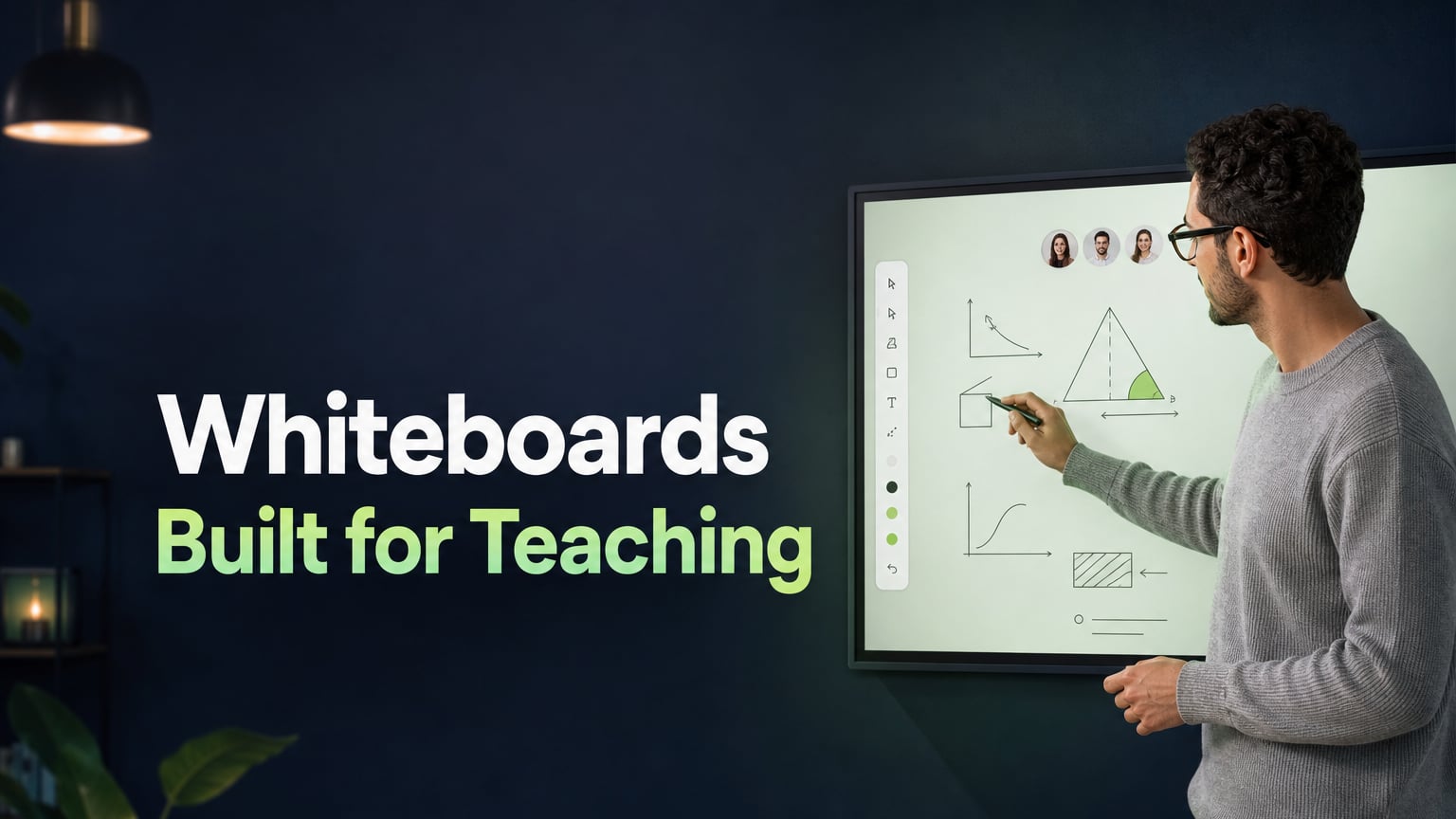
2. Use an Interactive Whiteboard
The majority of online teachers still use the passive slide presentations. The student cannot engage with it, so watching and listening become the only options.
However, when they are working on the interactive online board, they're working on the board alongside the teacher.
A dedicated interactive whiteboard for ESL tutoring lets you:
- Write and annotate in real time alongside the student
- Add images, PDF texts, and audio clips directly to the lesson board
- Have the student write, underline, or drag-and-drop answers themselves
- Save each board as a lesson record, so students can revisit exactly what they covered
Engagement changes significantly. When students see their work on the board, the corrections, and the overall input, not only it might make them proud of their work, but also their learning becomes more efficient.
Pro tip: Give the student their own color on the whiteboard from lesson one. This simple visual distinction ("your color is blue") signals that they're a co-author of the lesson, not just an observer.
3. Change Activities Every 10–15 Minutes
These days researchers show that the attention span drops dramatically. Adult ESL learners can maintain longer focus (roughly 10-15 minutes on one activity), while younger learners only 7-10 minutes.
Try to structure your lesson in a way that activities change in terms of format, output, and student engagement time.
A well-paced 60-minute ESL lesson might look like:
- 0–5 min: Warm-up (speaking or vocabulary review)
- 5–20 min: New input (reading text, explanation with whiteboard)
- 20–35 min: Guided practice (exercises the student completes on the board)
- 35–50 min: Freer practice (role play, writing task, discussion)
- 50–60 min: Review + goal check + homework assignment
The abovementioned rhythm gives the student's brain a series of fresh starts, and each transition resets their attention.
The activity variety also demonstrates the professionalism of the tutor, who is always in control of timing and structure, which, as a result, increases student's trust.
4. Make Progress Visible
Visible progress is something that not ESL tutors pay attention to.
When students can't see their progress, they come to think it's a waste of time. There is always the feeling of standing still and not making any progress at all. Without visible evidence of progress, they begin to question whether to continue lessons or not.
There are some practical ways to make progress visible in online ESL lessons:
- Track new vocabulary learnt - just keep the list on the student's profile or lesson notes
- Record errors from each lesson - so that later on you can show your students when the same error stops appearing
- Screenshot or save lesson boards - so that students can see the volume of work covered
- Use a simple milestone system - for example, "You've now used the present perfect correctly 12 times this month"
Moreover, when the parents ask "what has my child actually learned?", or when an adult student asks "am I improving?", you want to be able to show the progress evidence.
That ability to demonstrate tangible progress is one of the most powerful retention tools in your toolkit.
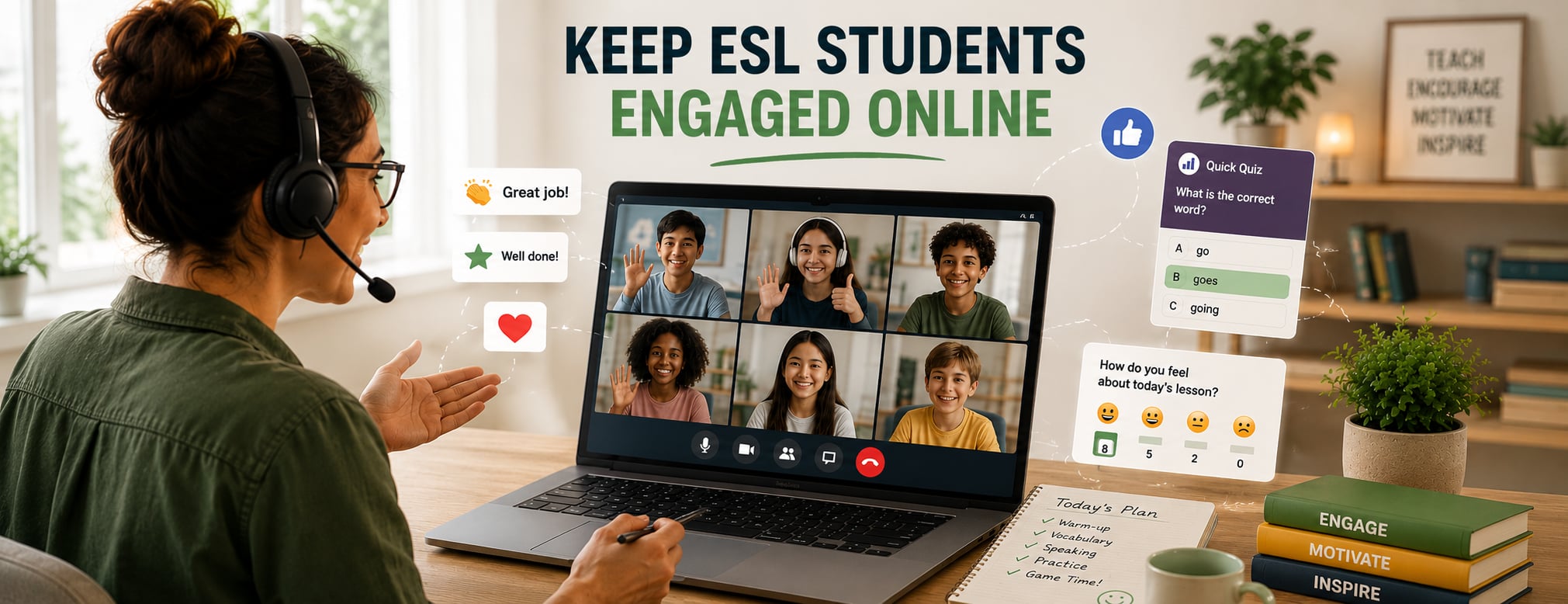
5. Use Real-Time Reactions to Check Understanding
In the physical classroom students can engage with you during the lesson by their body language. When you catch those signals, you instantly know what to do. Online, those signals disappear.
Unless you find the replacement.
One thing that is especially valuable for ESL learners is to communicate without breaking the lesson flow. For example, real-time reaction tools (such as emojis, thumbs up or down, confusion signals).
In the beginning of the lesson course, just give a hint to your student. For example, "Show me a thumbs up when you feel good about this, thumbs down when you need me to slow down."
Students who feel heard stay engaged, and you solve misunderstandings before they appear.
6. Assign Homework That Connects Directly to the Next Lesson
Homework is something the majority of students skip, just because it feels a bit disconnected from the lesson. Now, the homework which prepares me for the next lesson is something different.
When giving out homework tasks, you may say, for example: "Complete these six sentences using past perfect. In our next lesson, we're going to use these exact sentences as the starting point for a writing exercise."
If you want to be a professional, use the platform that gives you an opportunity to assign tasks directly from the lesson board. This way, students can access materials and review corrections in one place with no switching tabs or printing everything out.
Moreover, automatically checked written tasks saves you time and gives students instant feedback. That's the engagement we want to see in ESL online lessons.
7. Build a Reliable Technical Routine Students Can Count On
Engagement always relies on trust. Trust can be easily destroyed if your technical setup fails. For example, the frozen screen mid-explanation, a link that doesn't open or tabs you're switching between.
A reliable video call integrated into your lesson environment removes a significant source of anxiety for both you and the student. When the lesson just works, you are both mentally ready to focus on the English.
Create a consistent opening routine: same link, same structure, same board format. That's how students know exactly what to expect (and what to recommend to others!) when they join a lesson.
Predictability is a part of efficient engagement strategy.
The Tool That Ties It All Together
Of course, each of the strategies listed above works on its own. However, they work even better when you support all of them with one lesson environment.
A virtual classroom built for ESL tutors combines your video call, interactive whiteboard, homework assignment, student progress tracking, and lesson materials in a single tab. No switching. No "wait, let me send you the link." No technical scramble before a student who's already paid for their lesson time.
Class Spot is built specifically for one-on-one and small group online tutoring. Student reactions, homework module, and progress tracking are all integrated which means the strategies in this article are supported out of the box.
If you've been managing your lessons across Zoom, Miro, Google Slides, WhatsApp, and Quizlet simultaneously, the difference in cognitive load is immediate.
Frequently Asked Questions
How do I keep ESL students motivated to continue lessons?
The most effective retention strategy is visible progress. Students stay when they can see and feel improvement. Tracking vocabulary growth, corrected errors, and completed milestones gives students evidence that their time and money are producing results.
What makes online ESL lessons more engaging than traditional video calls?
Interactivity is the key differentiator. Lessons where students actively write, annotate, complete exercises, and receive real-time feedback on a shared whiteboard are dramatically more engaging than lessons where they mostly listen and respond verbally. The platform you use matters: if your setup requires constant tab-switching, it costs you engagement.
How often should ESL tutors review student progress?
Progress should be visible in every single lesson, not just during formal reviews. A brief two-minute summary at the end of each session, for example, "here's what we covered, here's what you did well, here's what we're working on next". Formal milestone reviews every four to six weeks help with broader motivation.
What is the best platform for one-on-one online ESL tutoring?
The best platform for ESL tutoring combines video calling, an interactive whiteboard, homework assignment, and progress tracking in a single integrated environment, so you're never switching between tools mid-lesson. Class Spot was built specifically for individual and small-group online tutoring, with all of these features in one place. You can start with a free account and run unlimited lessons.