December is a great time to make your English lessons feel lighter. Students often hear Christmas words in songs, films, and shops, and many ask about the holiday. These Christmas ESL activities work well for online lessons with one student or a small group. You won't need to print anything. Everything happens on the shared screen.
Below is a 45-minute lesson plan with timings and eight activities, including suggested phrases. There are versions for both adults and children, as well as ideas for students who don't celebrate Christmas. Preparing the whole lesson takes about ten minutes.
What makes a Christmas activity work online
Online Christmas activities work best when students have something to do on their own screen and a reason to speak. Many classroom ideas rely on crafts, group work, or moving around. With one student on a video call, choose tasks they can do with you, like guessing, describing, choosing, typing, and explaining.
Before adding an activity to your plan, ask yourself these three quick questions:
- Can my student do this with only me as a partner?
- Will it still work if they join from a phone?
- Will they say full sentences, or only single words?
If the answer to the last question is "single words", add a follow-up question each time. Asking "Why?" or "Tell me more" is usually enough.
Ten minutes of preparation
You only need one board, one set of words, and one website. Prepare them once and use them with every student this month.
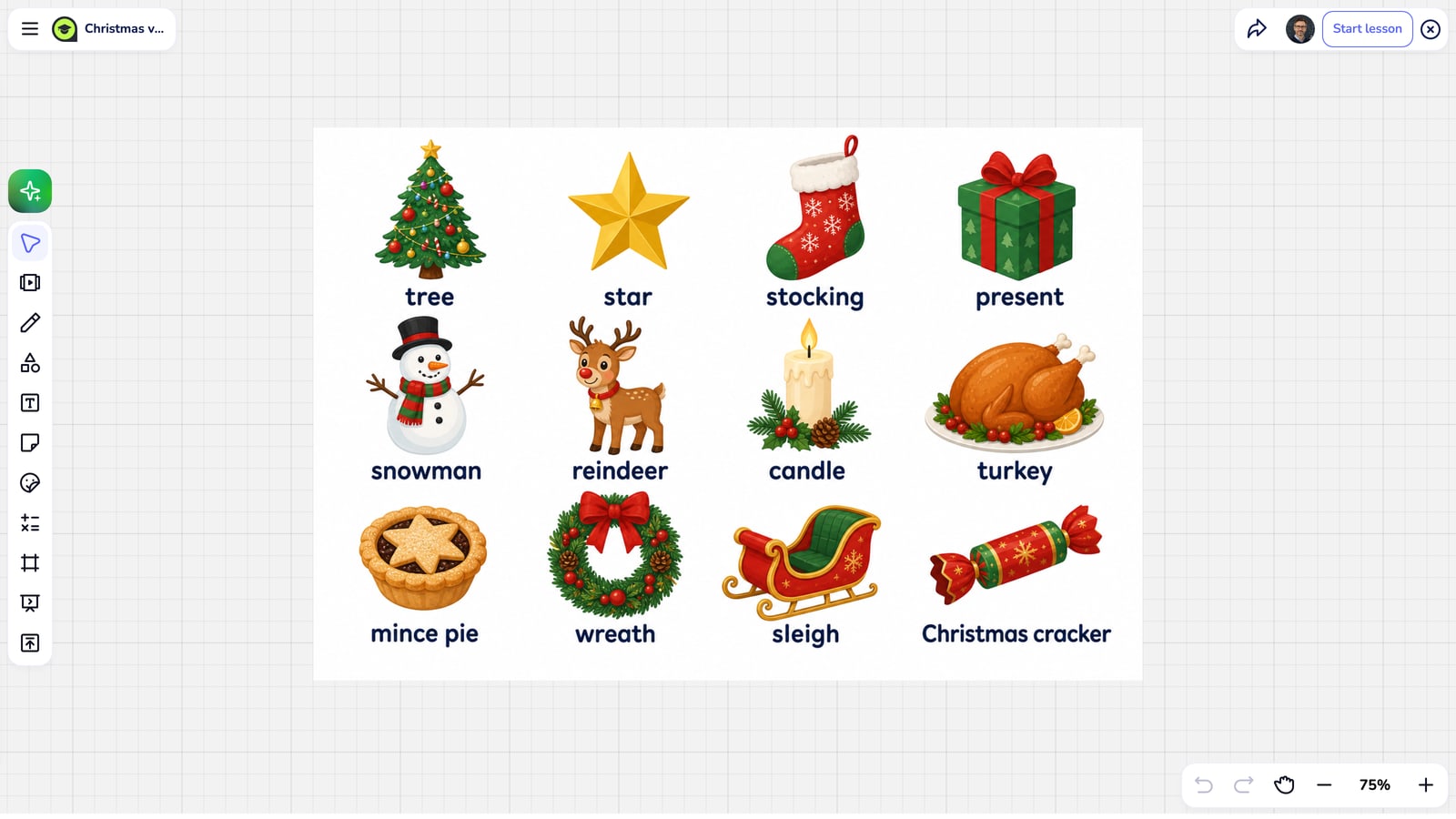
For the board, add 12 to 15 Christmas pictures to your online whiteboard. For beginners, pick items they can see and name, like tree, star, stocking, present, snowman, reindeer, candle, turkey, mince pie, wreath, sleigh, and Christmas cracker. For B1 students and above, include useful phrases such as put up the decorations, wrap a present, pull a cracker, stay in, and visit relatives.
For the words, turn the same list into flashcards with a picture and audio on each card. Your student hears each word before saying it, and you can send the set home after the lesson.
For the website, choose a trusted page for the last part of the lesson, such as a Christmas quiz or a page about celebrations in different countries. Make sure it opens correctly before the lesson begins.
A 45-minute Christmas lesson plan for one student
This plan works well for students at A2 or B1 level. For beginners, skip the writing task and spend more time on vocabulary games. For advanced students, skip the picture reveal and focus more on speaking tasks.
| Time | Activity | What your student does | What you can say |
|---|---|---|---|
| 0–5 min | One picture warm-up | Describes a Christmas street scene | "What can you see? What do you think these people are doing?" |
| 5–15 min | Picture reveal and flashcards | Guesses and repeats 12 words | "Say the word before I uncover the whole picture." |
| 15–25 min | Traditions swap | Compares the end of December at home with your answers | "What do people in your country do on 31 December?" |
| 25–35 min | What's in the box? | Asks yes/no questions about a hidden present | "You have 20 questions. Is it something you can eat?" |
| 35–42 min | Short message | Writes a wish list or an end-of-year message | "Write five sentences. I'll help you with the tricky words." |
| 42–45 min | Wrap-up | Chooses three new words to keep | "Which three words do you want to remember?" |
Save the last three minutes for a wrap-up. Your student will leave with a short list of words they chose, and you'll know what to review in January.
8 Christmas ESL activities that work online
Each activity below is designed for one student and a shared screen. The suggested level and time are just a guide, so adjust them to fit your student.
1. Picture reveal (A1 and up, 5 minutes)
Cover a picture on the board with shapes and remove them one at a time. Your student tries to guess the word as soon as possible. To make it harder, give a clue each time you remove a shape, like "It's something you hang on a tree."
2. What's in the box? (A2 and up, 8 minutes)
Think of a present and draw a box on the board. Your student can ask up to 20 yes/no questions to figure out what's inside. Write each question on the board as they ask, so you can correct the grammar together at the end. Then switch roles and let your student choose the present.
3. Odd one out (A2 and up, 5 minutes)
Show four pictures, such as a snowman, a reindeer, a sandcastle, and a sleigh. Your student chooses the one that doesn't belong and explains why. There's often more than one good answer, so you can ask, "Why do you think so?"
4. Plan a Christmas dinner (A2 to B1, 10 minutes)
Have your student plan a holiday meal for four people. They choose a starter, main course, and dessert, and explain their choices. With adults, compare it to a holiday meal in their country. This is a natural way to practise food words and expressions like "I'd like" or "We usually have".
5. Would you rather: winter edition (B1 and up, 5–8 minutes)
Ask questions like "Would you rather spend Christmas on a beach or in the snow?" or "Would you rather get one big present or ten small ones?" Your student answers and gives a reason. Ask a follow-up question each time to keep the chat going.
6. Describe the gift (A2 and up, 5 minutes)
Ask your student to describe a present without naming it: what it looks like and who would like it. You guess the answer. Then you describe one and your student guesses. This simple activity helps your student use adjectives and relative clauses naturally.
7. A Christmas story in five pictures (B1 and up, 10 minutes)
Place five pictures on the board in the wrong order. Your student arranges them in a logical order and tells the story using the past simple. Give them linking words before they start, such as first, then, after that, and in the end.
8. End-of-year message (B1 and up, 10 minutes)
This activity is great for adults who use English at work. Ask your student to write a short message (60 to 80 words) to a colleague or client, thanking them for the year and hoping they have a good break. Correct the message together on the board. Your student can send it for real the next day.
Students who don't celebrate Christmas
Some students may not celebrate Christmas or may have other holidays at this time of year. Ask before planning the lesson: "Do you celebrate anything at the end of the year?"
If your student doesn't celebrate Christmas, call the lesson "winter holidays" or "the end of the year". Switch some pictures for ones from their own celebration and keep the same activities. The traditions swap works especially well, as your student becomes the expert and explains their holiday to you.
Adults and children need different versions
The same activity might feel fun to a child but silly to an adult. Adjust the context, but keep the language goal the same.
| Activity | Children (A1–A2) | Adults (B1 and up) |
|---|---|---|
| What's in the box? | Toys and sweets | Gifts for colleagues, with a budget |
| Christmas dinner | Draw the plate and name the food | Plan a dinner for guests with dietary needs |
| Writing | A wish list of five items | An end-of-year message to a client |
| Vocabulary | Objects: tree, star, present | Phrases: wrap a present, stay in, Boxing Day |
If your adult student is interested in British traditions, explain terms such as Boxing Day and Christmas cracker. The Cambridge Dictionary has short definitions and audio, so your student can review them after the lesson.
Homework for the holiday break
Many students take a break from lessons during the holidays. Give them homework that takes just five minutes a day, so the new words stay fresh until your next lesson.
- Practise the Christmas word set for five minutes a day.
- Record a one-minute voice message about their day on 25 or 31 December.
- Write three sentences about a plan for January.
Begin your first lesson in January by listening to your student's voice message. It's a friendly way to restart lessons, and you'll quickly hear which words they remembered.
Where to start this week
- Choose 12 to 15 Christmas words for each level you teach.
- Build one board with the pictures and save it.
- Turn the words into a flashcard set with audio.
- Ask each student whether they celebrate Christmas or another holiday at the end of the year.
- Put the lesson into your December schedule, a week or two before your students' break.
For more ideas, check out our 15 quick games for the online classroom, 20 interactive activities for online English lessons, and English games for adult learners. If you need a structure for future lessons, read our guide on how to structure an online lesson.
Running the lesson in Class Spot
You can run the whole lesson in one Class Spot window. On the whiteboard, add pictures, audio, and text onto one canvas. Build the board before the lesson, save it, and open it again for your next student.
Turn the Christmas words into a Flash Cards deck with a picture and audio on each card. When you open the deck during the lesson, it appears on your student's screen, and they can practise in four ways: flip, quiz, type the word, and unscramble it. Playing a deck in the lesson works on every plan, and assigning it as homework starts with the Solo Max plan.
For the website part of the lesson, use Shared Tab Control to share a Chrome tab and let your student take control. They can click and type on the real page while you watch. The extension is only installed on your side, and your student joins with the usual lesson link.
Frequently asked questions
How do you teach Christmas vocabulary in an online lesson?
Add 12 to 15 pictures to a shared board and start with a picture reveal, so your student can guess each word. Then practise the same words as flashcards with audio. Finish with a speaking task, like a traditions swap, where your student uses the new words in full sentences.
What Christmas activities work for adult ESL students?
Adults usually enjoy tasks with a real purpose, such as a would-you-rather discussion, a traditions swap, a story in pictures, or writing an end-of-year email to a colleague. Keep the games, but give them an adult context, like choosing gifts for colleagues within a budget.
How do I run a Christmas lesson with a student who doesn't celebrate Christmas?
First, ask if your student celebrates anything at the end of the year. Then call the lesson "winter holidays" or "the end of the year" and swap in pictures of their own traditions. Let your student explain their holiday to you, as this gives them more to say.
Can you play Christmas games online with only one student?
Yes. Choose games where you can be the second player, like What's in the box?, Describe the gift, and Odd one out. Take turns so your student both asks and answers. Guessing and describing games work well one-to-one because each turn requires full sentences.
How long should a Christmas ESL lesson be?
Keep your usual lesson length. The plan above takes 45 minutes. For a 30-minute lesson, include the warm-up, picture reveal, and one speaking game, and assign the writing task as homework. For a 60-minute lesson, add the Christmas story in five pictures.