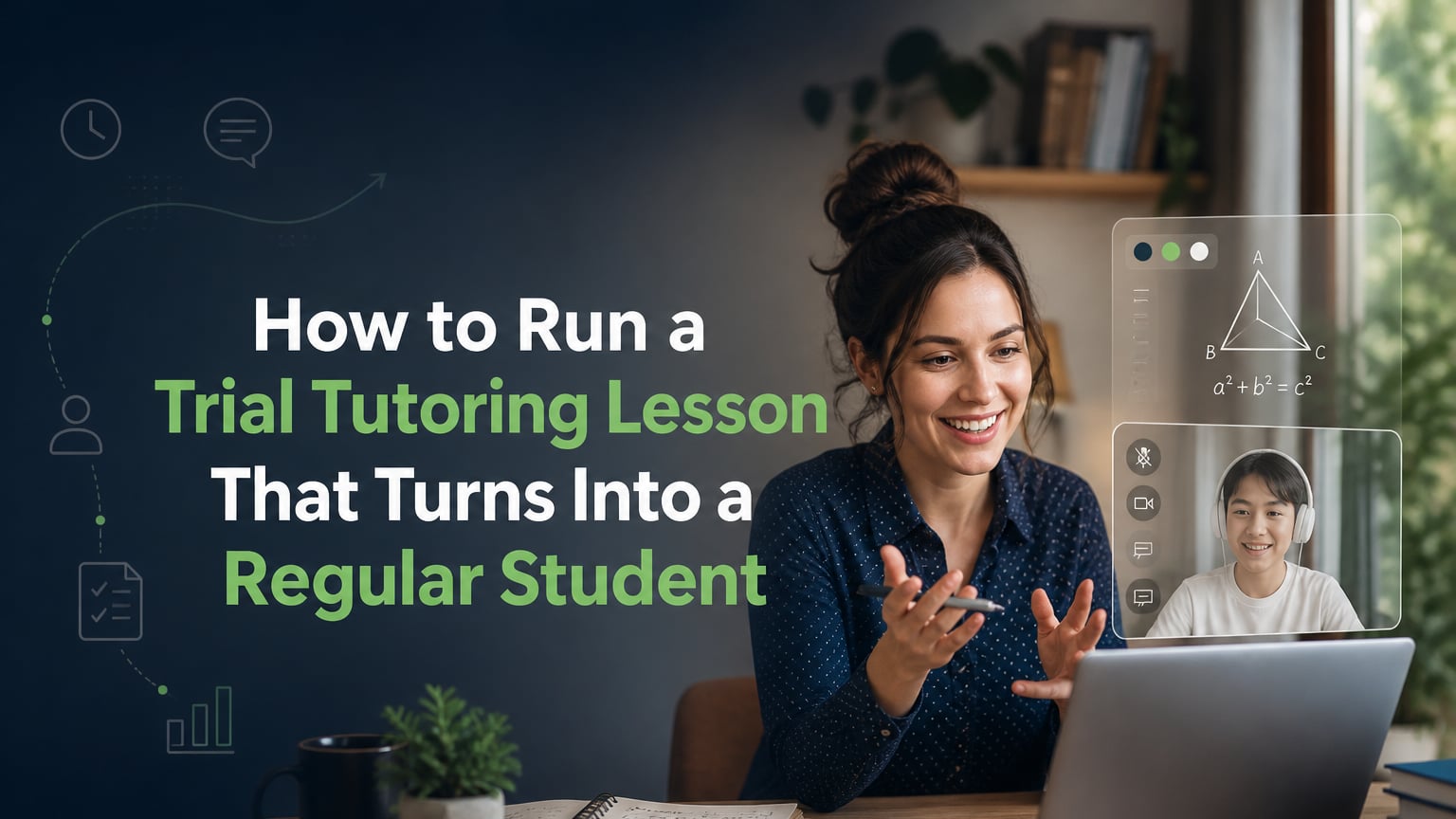
A new student has booked a trial tutoring lesson with you. In about 45 minutes, they'll decide if they want to keep learning with you, and you'll see if you can help them. Good teaching matters, but small details make a big difference too: a link that works, a lesson with a clear structure, and an ending where you both know what comes next.
This guide covers the whole trial: the message you send before, the lesson itself, and the message you send after. You'll get a minute-by-minute plan, sample words to offer a regular slot, and a follow-up message you can use today. If you're still working on getting trial bookings, start with our guide on how to find students for online teaching.
What is a trial tutoring lesson for?
A trial lesson has two main goals. First, show the student or their parent that you understand what they need. Second, agree on what happens next. You don't need to cover a whole topic or show every tool you use.
By the end of the trial, aim for three things: a clear idea of the student's level and goal, one small moment where they felt progress, and a yes or no about a regular slot. Each part of the plan below helps with one of these.
Should your trial lesson be free or paid?
Tutors use both options, and there isn't one right answer. What matters is choosing on purpose and making it clear before the student books.
| Option | Good for | Watch out for |
|---|---|---|
| Free trial lesson | Filling a new schedule; students who compare several tutors | No-shows and people who were never planning to continue |
| Paid trial lesson | A fuller schedule; students with a clear goal, such as an exam date | Fewer bookings, so your profile and booking page need to explain what the trial includes |
| Short free call, then a paid first lesson | Talking about goals before anyone commits money | Keep the call to 15–20 minutes so it doesn't turn into a free lesson |
No matter what you choose, include the price, lesson length, and what happens next in your booking message. Being clear about money from the start avoids awkward conversations later. If you're not sure what to charge, our guide on raising your online tutoring rate explains how students judge price.
Before the lesson: questions, link and a tech check
Send a short message as soon as the trial is booked. Confirm the time in the student's time zone, include the lesson link, and ask three questions:
- What would you like to be able to do in three months that you can't do now?
- What have you tried before, and what didn't work?
- Is there a date that matters, such as an exam, an interview, or a move abroad?
The answers help you prepare a task at the right level instead of guessing. For a child, send the questions to the parent and ask them to join for the first and last five minutes of the lesson.
Next, check your own setup. Open the link yourself, keep your materials together, and close any tabs you won't need. If the student can join by link without making an account, let them know in your message. This helps them feel more at ease before the lesson.
A 45-minute trial lesson plan
Here's a simple outline for a 45-minute trial. If your trial is 30 or 60 minutes, just shorten or lengthen each part as needed.
| Minutes | What you do | Why |
|---|---|---|
| 0–5 | Say hello, check sound and screen, explain the plan for today | The student relaxes and knows what to expect |
| 5–15 | Ask about goals, past learning and what feels hard; listen more than you talk | You hear the goal in the student's own words |
| 15–30 | Give one short task at their level and watch how they do it | You see their real level and how they think |
| 30–40 | Teach one small thing that fixes something you noticed | The student leaves with a visible win |
| 40–45 | Sum up what you saw and suggest the next step | The trial ends with a clear decision to make |
Minutes 5–15: listen and take notes
Ask open questions and write down the student's own words. If an adult learner says, "I freeze when my manager asks me something in a meeting", that tells you exactly what to work on. You'll use this again at the end of the lesson.
Minutes 15–30: one short, real task
Choose a task that shows a real skill in just a few minutes. For example:
- English with an adult: a two-minute role play of the situation they described, then a short round of corrections.
- Maths with a teenager: three questions from the topic they find hardest, getting harder each time, solved on a shared whiteboard so you can see every step.
- A language beginner: ten everyday phrases, then a short dialogue that uses them.
Watch how they work, not just if they get the answer right. Where do they slow down? Which steps do they skip? These notes help you plan lessons for the first month.
Minutes 30–40: a small win
Pick one thing you noticed and help them fix it right away: maybe a grammar pattern they struggle with, a step they skip in equations, or a sound they find hard. Let them try again. If a student can do something at minute 40 that they couldn't do at minute 20, they'll want to come back.
For regular lessons after the trial, our blueprint for structuring an online lesson will guide you from there.
How to end the trial with a clear next step
Save the last five minutes for this part, and stop the task on time to keep those minutes free. If the lesson runs over, it's easy to end with "let me know if you'd like to continue", but then the decision is left open.
Here's a simple four-step way to close the trial:
- Say what you noticed: "Today I saw that you know the rules well, but you slow down when you need to answer quickly."
- Say what you would work on: "In the first month, I'd focus on speaking in meetings and on quick answers to common questions."
- Offer two real slots and your price: "I have Tuesdays at 5 pm or Thursdays at 6 pm. Lessons are [your rate] for 50 minutes, paid monthly. Which suits you better?"
- Give them room to think: "If you'd like a day or two to decide, that's fine. I'll hold Tuesday at 5 pm for you until Friday."
Offering two specific times is easier to answer than asking "When are you free?" If you're teaching a child, share this summary with the parent while the child is present so they both hear the same plan.
What to send after the trial
Send a short message on the same day, while the lesson is still fresh for both of you. Focus on what you noticed, the plan, and the slot. Here's a template you can adapt:
Hi [name], thank you for today's lesson. Here's a quick summary.
What went well: [one specific thing].
What we'll work on first: [one or two things, in the student's own words].
Suggested plan: [number] lessons a week, [day and time], [price and how payment works].
If that works for you, just reply "yes", and I'll book it in. I'm holding [day and time] for you until [date].
[Your name]
For parents, put in a line about how you'll keep them updated, like a short note after each lesson and a summary at the end of each month. Our progress report templates can help with the monthly summary.
What to do if they don't book straight away
Some students need a few days to decide, and that's normal. Send a friendly follow-up two or three days later. Remind them about the slot you're holding and ask if they have any questions. If they don't reply after that, let it go.
If someone says no, ask a quick question: "Is there anything that would have made the lessons a better fit for you?" Their answer can help you improve your next trial.
It's helpful to keep a simple log of your trials: the date, where the student found you, whether it was free or paid, and if they booked. After ten or twenty trials, you'll start to see patterns, like students from one channel booking more often. Your own numbers will tell you more than any general average.
Where to start this week
- Write your three pre-lesson questions and save them as a message template.
- Decide whether your trial is free, paid, or a short free call, and say so on your booking page.
- Prepare two or three short tasks for the levels you see most often.
- Copy the follow-up message above and fill in your own details.
- Start a simple trial log in a spreadsheet.
Running trial lessons with Class Spot
If you teach with Class Spot, most of this process is already set up for you. You share your booking link, and the student or parent picks an open slot in your week. Booking reserves the lesson, and no payment is needed to book. The student opens the trial link in their browser and joins without creating an account. After the lesson, the summary and next-step message are sent to you, and the trial can become a regular slot in your schedule.
You can start for free, and you don't need a credit card. Get your booking link.
Frequently Asked Questions
How long should a trial tutoring lesson be?
Trial lessons can be between 30 and 60 minutes. Thirty minutes is enough to understand the goal and try one short task, but there's less time for a small win. Forty-five minutes gives you space for all five parts of the plan above. A full 60 minutes works well when the trial is paid, and you want it to feel like a normal lesson.
Should I offer a free trial lesson as a tutor?
It depends on your situation. A free trial helps when you're filling your schedule, and students are comparing tutors. A paid trial suits a busier schedule and students with a clear goal, like an exam. A short free call followed by a paid first lesson is a middle option. Whatever you choose, make it clear before the student books.
What should I do in a trial lesson with a child?
Ask a parent to join for the first and last five minutes. At the start, they can share the goal and any concerns. At the end, summarize what you noticed and suggest a plan for both. In the middle, keep tasks short and varied, and add one of these quick games for the online classroom to make the lesson fun.
Should a trial lesson test the student or teach them?
Do both, in that order. A short task shows you their real level, and teaching one small thing afterward shows them what your lessons are like. A trial that only tests can feel like an exam, and a trial that only teaches leaves you guessing about their level.
How soon should I follow up after a trial lesson?
Send a summary on the same day, while the lesson is still fresh for both of you. If you don't hear back, one friendly reminder two or three days later is enough. Mention the slot you're holding and when you'll release it, so the student knows a decision is needed.